

Why Security Frameworks Matter For SaaS Teams
If you sell software in 2026, you don’t just need “security.” You need to speak your customers’ language: SOC 2, ISO 27001, HIPAA, PCI DSS, and more.
The challenge for most 10–50 person SaaS teams is not learning every framework in detail; it’s deciding which one matters most for what you actually do.
In this guide, we’ll walk through the main frameworks our dashboard tracks—SOC 2, ISO 27001, HIPAA, PCI DSS, and CIS-style benchmarks—and explain which companies should care about which, and when.
A Quick Note Before We Dive In
Our AWS Security & Compliance Dashboard gives you “audit-ready global visibility” across multiple frameworks—SOC 2, ISO 27001, HIPAA, and more—from a single view.

- You don’t have to become a compliance expert to know where you stand. You just need to know which framework is your primary “north star” right now.
SOC 2 – The Default For B2B SaaS
What SOC 2 Does
- Focuses on how you protect customer data using the Trust Services Criteria: security, availability, processing integrity, confidentiality, and privacy.
- Results in an attestation report from a CPA firm (Type I: point in time, Type II: over a period).
- Gives your customers assurance that your controls are designed and operating effectively.
Who SOC 2 Is Good For
- B2B SaaS platforms selling into U.S. mid‑market and enterprise customers.
- Startups that keep getting security questionnaires that look suspiciously like SOC 2 checklists.
- Teams without a full-time security hire who still need to “speak enterprise.”
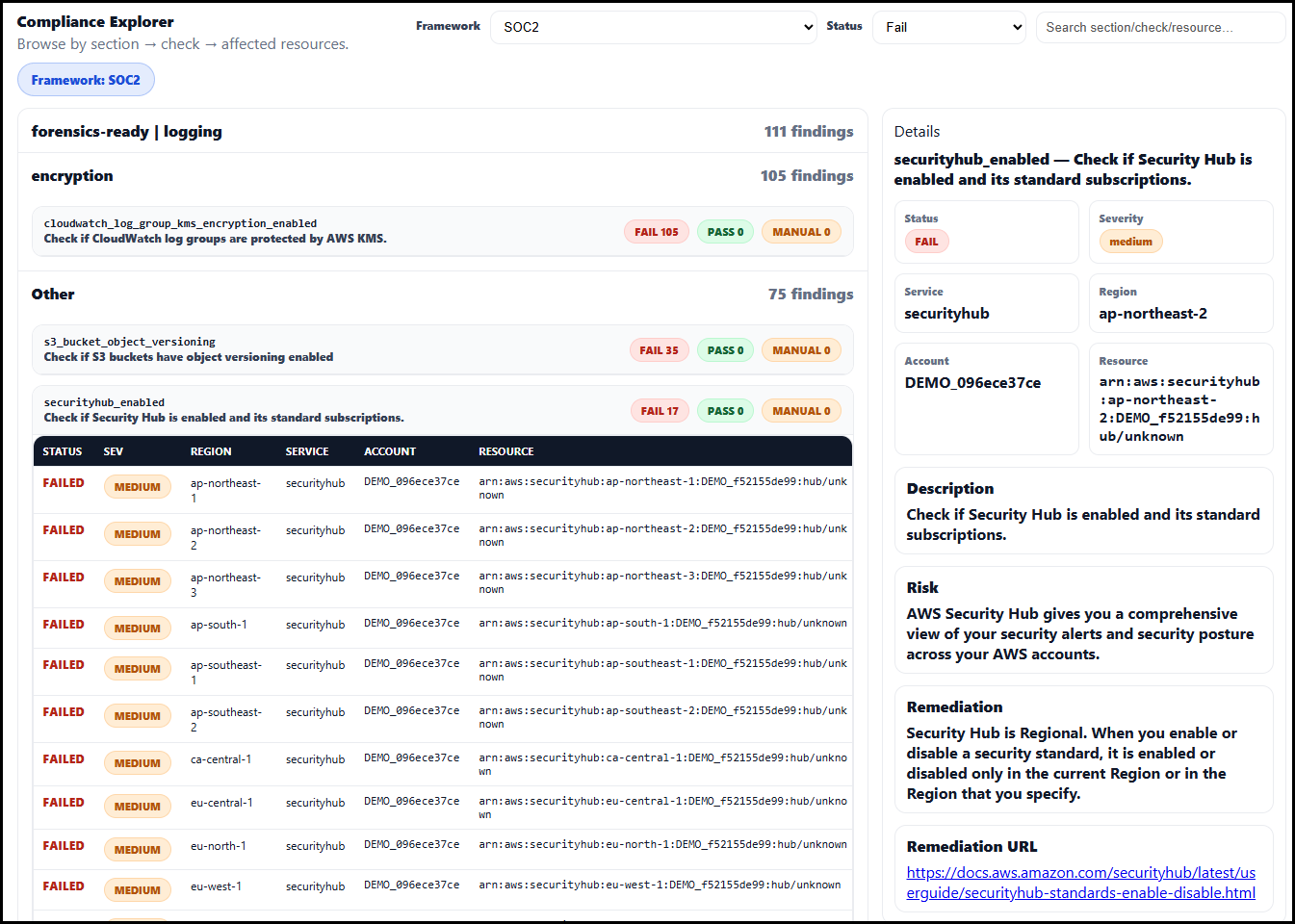
- If your company is a 10–50 person SaaS selling to U.S. businesses, SOC 2 is often the most important framework to tackle first—because it unblocks deals.
ISO 27001 – Global Security Management
What ISO 27001 Does
- Defines how you manage information security risks through policies, processes, and continuous improvement.
- Requires you to define scope, perform risk assessments, implement controls, and run an internal audit cycle.
- Results in a certification from an accredited body, not an attestation report.
Who ISO 27001 Is Good For
- SaaS companies selling globally, especially into Europe or highly regulated industries.
- Organizations that want a more formal, governance-focused approach, not just an “audit snapshot.”
- Scale-ups that already have SOC 2 or strong controls and now want a more mature security management program.

- If your customers are in multiple regions or are used to ISO language in RFPs, ISO 27001 may become as important—or more important—than SOC 2 over time.
HIPAA – For Healthcare And PHI
What HIPAA Does
- Sets requirements for safeguarding health data, including privacy, security, and breach notification rules.
- Applies directly to covered entities (healthcare providers, plans, etc.) and indirectly to their business associates (including many SaaS vendors).
- Does not have a single official “certification,” but customers often expect HIPAA-aligned controls and documentation.
Who HIPAA Is Good For
- SaaS products that store, process, or transmit PHI, or integrate deeply into healthcare workflows.
- Data platforms that act as processors for healthcare customers.

- If you’re nowhere near healthcare, HIPAA is probably not your first priority; if you are, it’s absolutely non‑negotiable.
PCI DSS – For Payment Card Data
What PCI DSS Does
- Defines technical and operational requirements for systems that store, process, or transmit cardholder data.
- Includes controls around network segmentation, encryption, monitoring, and access control.
- Requires assessments (SAQ or full audit) based on your merchant or service provider level.
Who PCI DSS Is Good For
- Platforms that directly handle card data (for example, acting as a payment gateway or storing card numbers).
- Fintech or embedded finance products where you’re close to the card data flow.

- If you only ever touch tokens from a provider like Stripe or Braintree and never see card numbers, PCI DSS pressure is usually much lower—but your customers may still ask how you segregate and protect payment-related data.
CIS-Style Benchmarks And Best-Practice Baselines
What CIS-Style Benchmarks Do
- Define concrete, technical controls for things like IAM, logging, encryption, and network exposure.
- Often map into higher-level frameworks like SOC 2 and ISO 27001.
- Provide a clear checklist of “secure by default” configurations you can apply early.
Who CIS-Style Benchmarks Are Good For
- Early‑stage teams that are not yet under formal audit pressure but want strong hygiene.
- Engineering‑led organizations that want something concrete they can implement in Terraform, CloudFormation, or through your cloud security tooling.

- For many seed to Series A SaaS startups, a CIS-style baseline plus good logging, strong IAM, and encryption everywhere will quietly do more for real security than chasing a badge too early.
So… Which Framework Is “Most Important”?
The annoying but honest answer: it depends who you serve and what you store.
Here’s a simple way to think about it:
- B2B SaaS selling mainly to U.S. mid‑market and enterprise
Most important initial focus: SOC 2 (Type I and then Type II)
Why: Directly answers the security questions those buyers already ask. - Global or EU-heavy customer base
Most important initial focus: ISO 27001 (with or after SOC 2)
Why: Aligns with international expectations and governance-heavy buyers. - Healthcare or PHI workloads
Most important initial focus: HIPAA-aligned controls (plus SOC 2 or ISO)
Why: Required to handle PHI and pass vendor diligence. - Handling card data directly
Most important initial focus: PCI DSS (plus strong technical baselines)
Why: Mandatory if you store, process, or transmit card data. - Very early-stage, no major enterprise deals yet
Most important initial focus: CIS-style baseline and good cloud hygiene
Why: Gives real risk reduction and prepares you for future audits.
You don’t have to do everything at once. You need to pick the one that your customers expect and that you can realistically execute in the next 6–12 months.
How Our Dashboard Supports All Of These
The CloudWizard Security & Compliance Dashboard is designed to give you a single, consistent view of your AWS risk and compliance posture across frameworks.
- Multi-framework compliance scorecards (SOC 2, ISO 27001, HIPAA and more) with “change from last scan” and “compliance drift” indicators.
- Security maturity scoring and risk-weighted recommendations that map back to real misconfigurations, not just paperwork.
- A 90‑day roadmap that turns findings into a phased plan your engineering team can actually ship.

- Whether you’re answering a SOC 2 auditor, an ISO 27001 lead auditor, a healthcare compliance officer, or a fintech partner, you see where you stand in one place—without needing five separate tools.
Whatever Your Framework, We’ve Got You Covered
At the end of the day, frameworks are just different lenses on the same underlying reality: how seriously you take protecting your customers’ data.
If you’re not sure which framework should come first, or how to map your AWS environment to SOC 2, ISO 27001, HIPAA, PCI DSS, or a solid CIS-style baseline, that’s exactly what we help teams figure out.
Whatever framework you need, we have you covered—and we’ll meet you where you are, with clear visibility, practical guidance, and a roadmap your team can feel genuinely good about.
Why Security Frameworks Matter For SaaS Teams
If you sell software in 2026, you don’t just need “security.” You need to speak your customers’ language: SOC 2, ISO 27001, HIPAA, PCI DSS, and more.
The challenge for most 10–50 person SaaS teams is not learning every framework in detail; it’s deciding which one matters most for what you actually do.
In this guide, we’ll walk through the main frameworks our dashboard tracks—SOC 2, ISO 27001, HIPAA, PCI DSS, and CIS-style benchmarks—and explain which companies should care about which, and when.
A Quick Note Before We Dive In
Our AWS Security & Compliance Dashboard gives you “audit-ready global visibility” across multiple frameworks—SOC 2, ISO 27001, HIPAA, and more—from a single view.
- You don’t have to become a compliance expert to know where you stand. You just need to know which framework is your primary “north star” right now.
SOC 2 – The Default For B2B SaaS
What SOC 2 Does
- Focuses on how you protect customer data using the Trust Services Criteria: security, availability, processing integrity, confidentiality, and privacy.
- Results in an attestation report from a CPA firm (Type I: point in time, Type II: over a period).
- Gives your customers assurance that your controls are designed and operating effectively.
Who SOC 2 Is Good For
- B2B SaaS platforms selling into U.S. mid‑market and enterprise customers.
- Startups that keep getting security questionnaires that look suspiciously like SOC 2 checklists.
- Teams without a full-time security hire who still need to “speak enterprise.”
- If your company is a 10–50 person SaaS selling to U.S. businesses, SOC 2 is often the most important framework to tackle first—because it unblocks deals.
ISO 27001 – Global Security Management
What ISO 27001 Does
- Defines how you manage information security risks through policies, processes, and continuous improvement.
- Requires you to define scope, perform risk assessments, implement controls, and run an internal audit cycle.
- Results in a certification from an accredited body, not an attestation report.
Who ISO 27001 Is Good For
- SaaS companies selling globally, especially into Europe or highly regulated industries.
- Organizations that want a more formal, governance-focused approach, not just an “audit snapshot.”
- Scale-ups that already have SOC 2 or strong controls and now want a more mature security management program.
- If your customers are in multiple regions or are used to ISO language in RFPs, ISO 27001 may become as important—or more important—than SOC 2 over time.
HIPAA – For Healthcare And PHI
What HIPAA Does
- Sets requirements for safeguarding health data, including privacy, security, and breach notification rules.
- Applies directly to covered entities (healthcare providers, plans, etc.) and indirectly to their business associates (including many SaaS vendors).
- Does not have a single official “certification,” but customers often expect HIPAA-aligned controls and documentation.
Who HIPAA Is Good For
- SaaS products that store, process, or transmit PHI, or integrate deeply into healthcare workflows.
- Data platforms that act as processors for healthcare customers.
- If you’re nowhere near healthcare, HIPAA is probably not your first priority; if you are, it’s absolutely non‑negotiable.
PCI DSS – For Payment Card Data
What PCI DSS Does
- Defines technical and operational requirements for systems that store, process, or transmit cardholder data.
- Includes controls around network segmentation, encryption, monitoring, and access control.
- Requires assessments (SAQ or full audit) based on your merchant or service provider level.
Who PCI DSS Is Good For
- Platforms that directly handle card data (for example, acting as a payment gateway or storing card numbers).
- Fintech or embedded finance products where you’re close to the card data flow.
- If you only ever touch tokens from a provider like Stripe or Braintree and never see card numbers, PCI DSS pressure is usually much lower—but your customers may still ask how you segregate and protect payment-related data.
CIS-Style Benchmarks And Best-Practice Baselines
What CIS-Style Benchmarks Do
- Define concrete, technical controls for things like IAM, logging, encryption, and network exposure.
- Often map into higher-level frameworks like SOC 2 and ISO 27001.
- Provide a clear checklist of “secure by default” configurations you can apply early.
Who CIS-Style Benchmarks Are Good For
- Early‑stage teams that are not yet under formal audit pressure but want strong hygiene.
- Engineering‑led organizations that want something concrete they can implement in Terraform, CloudFormation, or through your cloud security tooling.
- For many seed to Series A SaaS startups, a CIS-style baseline plus good logging, strong IAM, and encryption everywhere will quietly do more for real security than chasing a badge too early.
So… Which Framework Is “Most Important”?
The annoying but honest answer: it depends who you serve and what you store.
Here’s a simple way to think about it:
- B2B SaaS selling mainly to U.S. mid‑market and enterprise
Most important initial focus: SOC 2 (Type I and then Type II)
Why: Directly answers the security questions those buyers already ask. - Global or EU-heavy customer base
Most important initial focus: ISO 27001 (with or after SOC 2)
Why: Aligns with international expectations and governance-heavy buyers. - Healthcare or PHI workloads
Most important initial focus: HIPAA-aligned controls (plus SOC 2 or ISO)
Why: Required to handle PHI and pass vendor diligence. - Handling card data directly
Most important initial focus: PCI DSS (plus strong technical baselines)
Why: Mandatory if you store, process, or transmit card data. - Very early-stage, no major enterprise deals yet
Most important initial focus: CIS-style baseline and good cloud hygiene
Why: Gives real risk reduction and prepares you for future audits.
You don’t have to do everything at once. You need to pick the one that your customers expect and that you can realistically execute in the next 6–12 months.
How Our Dashboard Supports All Of These
The CloudWizard Security & Compliance Dashboard is designed to give you a single, consistent view of your AWS risk and compliance posture across frameworks.
- Multi-framework compliance scorecards (SOC 2, ISO 27001, HIPAA and more) with “change from last scan” and “compliance drift” indicators.
- Security maturity scoring and risk-weighted recommendations that map back to real misconfigurations, not just paperwork.
- A 90‑day roadmap that turns findings into a phased plan your engineering team can actually ship.
- Whether you’re answering a SOC 2 auditor, an ISO 27001 lead auditor, a healthcare compliance officer, or a fintech partner, you see where you stand in one place—without needing five separate tools.
Whatever Your Framework, We’ve Got You Covered
At the end of the day, frameworks are just different lenses on the same underlying reality: how seriously you take protecting your customers’ data.
If you’re not sure which framework should come first, or how to map your AWS environment to SOC 2, ISO 27001, HIPAA, PCI DSS, or a solid CIS-style baseline, that’s exactly what we help teams figure out.
Whatever framework you need, we have you covered—and we’ll meet you where you are, with clear visibility, practical guidance, and a roadmap your team can feel genuinely good about.